Jon Finch’s guide provides a simplified, beginner-friendly introduction to Brew in a Bag (BIAB), a cost-effective method for crafting all-grain beer at home using minimal equipment. The text outlines the fundamental stages of the process, including steeping grains, boiling with hops, and fermentation. Emphasis is placed on the vital role of sanitization to prevent contamination and ensure high-quality results. Readers are guided through a list of essential household tools, such as a large pot and a mesh bag, alongside a basic American Pale Ale starter recipe. Additionally, the source includes a diverse collection of sample recipes—ranging from IPAs to Saisons—and suggests further resources for those looking to expand their brewing expertise.
Section-by-Section Summary
- Introduction (Pages 3-4): This section introduces the “Brew in a Bag” (BIAB) method as a simple and cheap alternative to traditional, complex all-grain brewing setups. The author shares their personal experience and states the guide’s purpose is to provide the bare minimum information needed to get started, not to delve into deep technical theory.
- How to Brew Beer (Page 5): A high-level overview of the basic steps in brewing beer is provided. It also introduces the specific recipe that will be used for the guide’s walkthrough: a 19L batch of American Pale Ale.
- Basic Equipment for BIAB (Pages 7-8): This section lists the essential equipment needed for BIAB brewing. It highlights that most items are common kitchen tools (large pan, spoon, scales), with the only specialized purchases likely being a mesh bag, a fermenter with an airlock, and a sanitiser.
- Ingredients (Page 9): The specific ingredients for the American Pale Ale recipe are listed: Pale Ale Malt, Northern Brewer/Centennial hops, Cascade hops, and Safale S-04 yeast. It also offers tips on purchasing ingredients, such as buying malt in bulk to save money.
- Sanitisation made easy (Pages 10-11): This section emphasizes that sanitisation is the most crucial part of brewing. It recommends using Oxi-Clean for cleaning and Star-San as a no-rinse sanitiser, providing a simple, step-by-step process for cleaning and sanitising equipment.
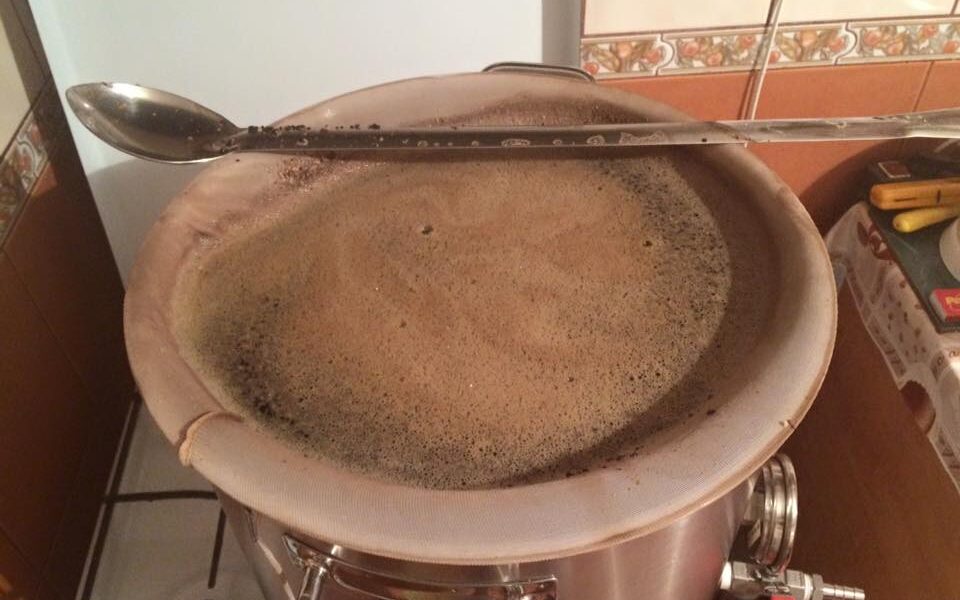
- Step by Step Brewday (Pages 12-22): This is the core instructional section, providing a detailed, illustrated guide to a complete brew day. It covers heating water, adding the grain-filled mesh bag (“mashing”), rinsing the grains (“sparging”), boiling the sugary liquid (“wort”), adding hops at specific times, cooling the wort quickly, and transferring it to the fermenter. It also includes a subsection on how to adapt the process for a smaller pot (Page 22).
- Fermenting and conditioning (Pages 23-24): This section explains the post-brew day process. It recommends a primary fermentation of two weeks at a stable temperature (18-21°C), followed by an optional transfer to a secondary vessel for another two weeks of conditioning and “cold crashing” to improve the beer’s clarity and flavour.
- Bottle or Keg? (Pages 25-28): The guide discusses the pros and cons of the three main packaging options: bottling, plastic kegs, and Cornelius (“Corny”) kegs. While the author prefers kegging for convenience, detailed instructions for cleaning, sanitising, filling, and carbonating bottles are provided.
- Understanding brew recipes (Pages 29-31): This section decodes the standard terminology and metrics found in beer recipes. It explains concepts like Original Gravity (OG), Final Gravity (FG), IBU (bitterness), and SRM/EBC (color), enabling the reader to interpret other recipes.
- Recipes (Pages 32-48): A collection of eight sample recipes is provided for various beer styles, including Pale Ale, IPA, Saison, Steam Beer, Pilsner, Christmas Beer, Weißbräu, and a clone of Stone IPA. Each recipe includes ingredients, target statistics, and brewing notes.
- Brewing Resources (Pages 49-50): The final section lists recommended online resources (podcasts, forums), brewing software, and books to help the reader continue their homebrewing journey.
